Draft Case Study
Azure Landing Zone and Terraform/OpenTofu Automation
Teams need consistent subscription onboarding and policy controls without duplicating infrastructure code.
Problem
Teams need consistent subscription onboarding and policy controls without duplicating infrastructure code.
Architecture
Draft architecture uses modular Terraform/OpenTofu components for management groups, policy assignments, networking, and baseline observability.
Reference/proposed architecture diagram for portfolio demonstration. Not a client production architecture.
View sanitized landing zone diagram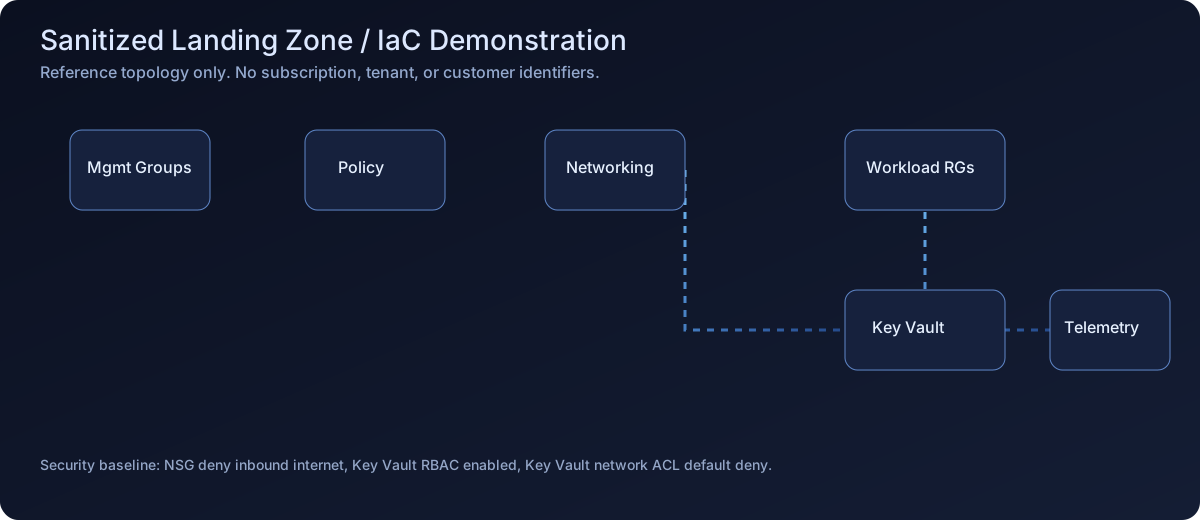
Architecture Explorer
Landing Zone / IaC: Sanitized modular governance and platform baseline.
Data flow: Platform policy and network baselines propagate from governance layers to shared services and observability.
Accessible alternative: use the component buttons below to inspect architecture details without zoom.
Legend
- Ingress / Trigger
- Orchestration
- Data / Storage
- Security
- Observability
- Operations
- Management Groups -> Policy Assignments (governance scope)
- Policy Assignments -> Shared Networking (policy baseline)
- Shared Networking -> Workload Subscriptions (shared connectivity)
- Shared Networking -> Diagnostics Workspace (diagnostic routing)
- Workload Subscriptions ~> Diagnostics Workspace (platform telemetry)
Component Details
Management Groups
Organize subscription hierarchy and governance inheritance.
Responsibilities: Hierarchy control | Policy scope boundaries
Security controls: Least-privilege role assignments | Policy inheritance governance
Dependencies: Policy Assignments
Design decisions: Use modular hierarchy definitions to avoid monolithic platform templates.
- Reference diagram uses generic naming only.
- No tenant, subscription, or private network details included.
Security
Draft security model applies least privilege, policy-as-code, and secure state management patterns.
Verified Outcomes
- Draft: improved governance consistency across onboarding workflows.
- Draft: reduced manual configuration drift in platform baselines.
Design Decisions
- Use module composition over monolithic templates to support environment-specific policy layering.
- Separate governance controls from workload modules to keep policy updates independent.
- Adopt deterministic naming and tagging conventions for predictable onboarding automation.
Implementation
- Create reusable OpenTofu/Terraform modules for hierarchy, networking, policy assignment, and diagnostics.
- Define environment overlays to standardize defaults while allowing approved exceptions.
- Validate module behavior with plan checks before promotion to shared module registries.
Trade-offs
- Stronger governance can slow edge-case onboarding when exceptions are not pre-modeled.
- Reusable modules increase consistency but require disciplined version management.
Engineering Evidence
Implemented demo evidenceImplemented Source Files
Landing zone root module composition
infrastructure/landing-zone/main.tfImplemented
Input variables with validation constraints
infrastructure/landing-zone/variables.tfImplemented
Sanitized example input values
infrastructure/landing-zone/terraform.tfvars.exampleImplemented
Reusable resource-group module
infrastructure/landing-zone/modules/resource-group/main.tfImplemented
Reusable networking + NSG module
infrastructure/landing-zone/modules/networking/main.tfImplemented
Reusable Key Vault security module
infrastructure/landing-zone/modules/key-vault/main.tfImplemented
Reproducible IaC instructions and limitations
infrastructure/landing-zone/README.mdImplemented
Credential-free CI checks (fmt/validate/plan/security)
.github/workflows/landing-zone-iac-checks.ymlImplemented
Sanitized static architecture diagram
public/diagrams/landing-zone-sanitized.svgImplemented
Automated IaC configuration tests
tests/landing-zone-iac.test.tsImplemented
Architecture Evidence
Diagram classification: Proposed
Sanitized data flow: Governance hierarchy applies policy and shared networking baselines, then workload subscriptions emit diagnostics to centralized observability.
Diagram source id: azure-landing-zone-iac-modules
Evidence pending: no implemented demo route is linked for this case study.
Automated Tests and Results
IaC file presence, module composition, validation rules, and README command coverage
tests/landing-zone-iac.test.ts
Diagram data schema and sanitization checks
tests/architecture-explorer.test.ts
Latest test run (2026-09-26): Repository tests pass, including landing-zone file/module/validation-command checks. Terraform/OpenTofu CLI checks are not performed in this environment because the CLIs are unavailable.
Command: node_modules/.bin/tsc.cmd -p tsconfig.test.json && node --test .test-dist/tests/**/*.test.js (includes landing-zone-iac tests)
Latest build run (2026-09-26): Production build completed successfully with prerendered case-study routes and both interactive demo routes.
Command: node_modules/.bin/next.cmd build
Limitations and Verification Gaps
- This is a sanitized local demonstration and does not execute terraform apply in this repository workflow.
- Azure deployment verification is explicitly not performed in this repository evidence set.
Evidence Pending
- Run terraform/tofu fmt, init, validate, and plan locally where Terraform/OpenTofu CLI is installed, then capture outputs.
- Azure deployment verification: Not performed / Evidence pending.
Evidence Status
- Local checks: Local repository checks executed (lint, typecheck, node tests, Next.js build). Terraform/OpenTofu CLI checks not performed in this environment.
- CI checks: CI workflow added for fmt/init/validate/plan/tfsec without Azure credentials.
- Azure deployment: Not performed / Evidence pending. No Azure subscription deployment executed.
Reproduction and Dependencies
Dependencies
- Node.js (current project uses Next.js 16.x, React 19.x, TypeScript 6.x)
- npm install
- Local binaries under node_modules/.bin for lint/typecheck/test/build
Reproduction steps
- cd infrastructure/landing-zone
- terraform fmt -check -recursive
- terraform init -backend=false
- terraform validate
- terraform plan -refresh=false -var-file=terraform.tfvars.example -out=tfplan
- Open /projects/azure-landing-zone-iac-modules and /diagrams/landing-zone-sanitized.svg